Insights / Tactical Analysis
Tactical AnalysisWhy underdogs win more than you think
ParallaxEdge Research · May 22, 2026 · 10 min read
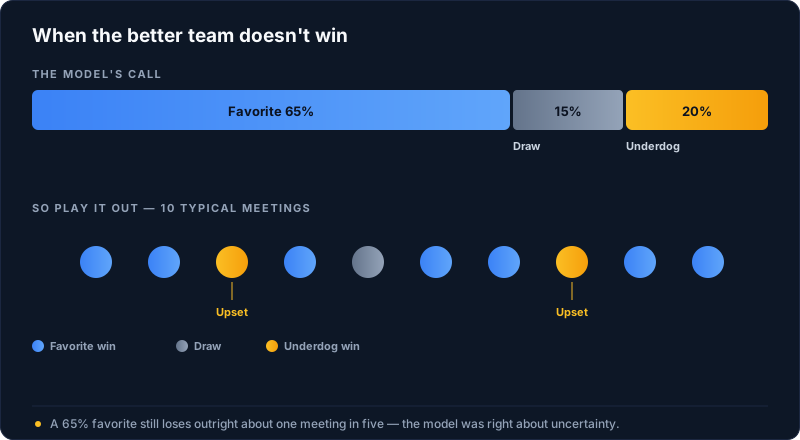
Soccer punishes anyone who treats the better team as the certain winner. The sport is low scoring, and a low-scoring game is a noisy one: a single deflection, a marginal offside call, or one save can decide ninety minutes. That noise is not a rare intrusion on an otherwise orderly contest. It is a permanent feature of the sport, and it is the reason underdogs win far more often than most fans expect.
Start with a clean example. Suppose a model judges that a strong side deserves to win a given match 65 percent of the time, with a 15 percent chance of a draw and a 20 percent chance of defeat. Those are healthy numbers for a clear favorite. Yet they also say something uncomfortable: this favorite will fail to win more than a third of the time, and will lose outright in one match out of every five. Play the fixture on five different weekends and you should expect to see an upset on one of them.
People hear '65 percent favorite' and round it up to 'should win.' The model is saying something more careful. It is describing a spread of possible results and telling you which is most common, not promising the common one will arrive on this particular day.
Why is the spread so wide in soccer when it feels narrow elsewhere? Scoring events are rare. A match might contain two or three goals in total, and each one carries enormous weight. In a sport with many scoring events, like basketball, the better team has dozens of possessions for its edge to assert itself, and the final margin usually reflects the gap in quality. In soccer there are too few goals for the law of large numbers to do its work inside a single game. The better team's edge is real, but ninety minutes is simply not enough time for it to show reliably.
We can put numbers on this. Run a season of fixtures through the simulator tens of thousands of times and the pattern is consistent: favorites underperform their underlying quality in the short run far more often than intuition suggests, purely because of how few scoring events a match contains. The stronger side still wins the most often. It just wins less often than its quality alone would imply if results were tidy.
This is why a good forecast does not look like a confident pundit. A pundit names a winner. A model hands you a distribution and refuses to pretend the tail does not exist. The 20 percent in our example is not hedging or weakness — it is the honest size of the underdog's chance, and over a long enough run of matches it will come in almost exactly that often.
The practical consequence is a different way of reading results. When an underdog wins, the instinct is to say the model was wrong. Usually it was not. A 20 percent event happening is not evidence against a forecast; it is the forecast working as intended. You would only have grounds to doubt the model if 20 percent events started arriving far more or far less often than one time in five across many matches. A single surprising scoreline tells you nothing.
The same logic protects you from overreacting when a favorite cruises to victory. One comfortable win does not prove the favorite was a lock, any more than one upset proves it was overrated. Both are single draws from a distribution. Quality reveals itself over a season, not over an afternoon.
None of this means upsets are random in aggregate. Some matchups genuinely carry more variance than others: a disciplined low block against a dominant attacker, a knockout tie where one team only needs to survive, a fixture with heavy rotation or fatigue. Our volatility measure is built to flag exactly these situations, where the spread around the favorite is unusually wide and an upset is more live than the headline number alone would suggest.
So the takeaway is not that favorites are overrated — it is that certainty is. The better team usually wins, and you should expect it to. You should also expect it to lose more often than feels comfortable, because in a low-scoring sport that is not a bug in the forecast. It is the truth the forecast is trying to tell you.
Want deeper insights?
Join the waitlist for advanced simulations, full distributions, and model explanations.