Insights / Markets
MarketsReading markets vs our models
ParallaxEdge Research · May 18, 2026 · 9 min read
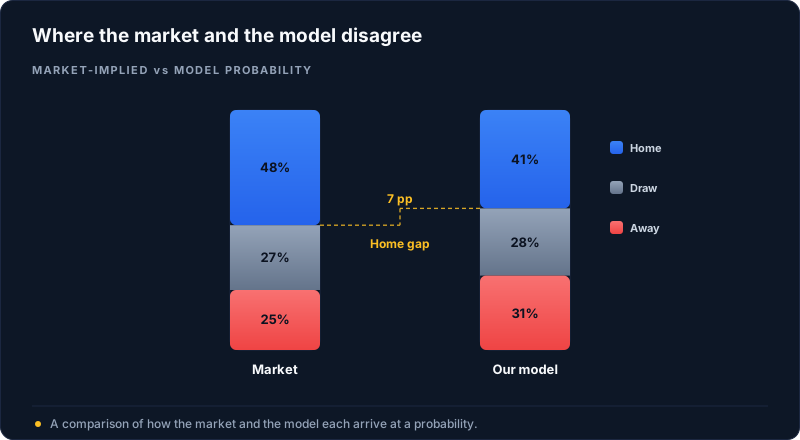
The market and a forecasting model are two different machines pointed at the same question: how likely is each result? They often return different answers, and the gap between them is more interesting than either number on its own. This article looks at why they diverge and what a thoughtful reader can take from the comparison.
First, a translation. A market price can be converted into an implied probability, the chance the market is effectively assigning to an outcome once you strip out the built-in margin. That implied probability is what we compare against the model. We are comparing two probabilities, not a price against a model.
The market has genuine strengths. It aggregates an enormous amount of information very quickly, and it folds in things a structured model may not see: a late injury, a manager resting players before a bigger fixture, travel, weather, even rumor. The number reacts fast, often before the news is widely reported. As a quick, broad summary of what is known, a market is hard to beat.
The market also carries characteristic distortions. It responds to where attention flows, and attention does not flow evenly. Popular teams draw disproportionate interest, which can shade the number. Public sentiment, recency, and the simple pull of a famous name all leave fingerprints. A market is a crowd, and a crowd is informative and biased at the same time.
A model is the opposite kind of instrument. It reacts only to the structured inputs it is given: team ratings, expected goals, home advantage, recent form, rest. It has no opinion about glamour and feels no pull to round a number up. Its weakness is the mirror image of its strength. If something real is happening that the inputs do not capture — a late tactical change, a locker-room story — the model will not know.
Put those two instruments side by side and disagreement is the normal state, not the exception. Most of the time the gap is small and uninteresting. Sometimes it is wide, and a wide gap is worth pausing on, because it usually has a cause rather than meaning one side is simply broken.
There are a few common explanations. The market may be holding information the model cannot see, in which case the market is probably closer to the truth. The model may be anchored to structural signal that the market is currently overlooking in favor of a narrative, in which case the gap may close back toward the model as the noise fades. Or the two may simply be weighting the same facts differently. Naming the likely cause matters far more than declaring a winner.
This is also why we do not treat the market as a target to be matched. If the goal were to reproduce the price, the model would add nothing. Its value is precisely that it forms an independent view from transparent inputs, so that when the two disagree you have two perspectives to reason with instead of one.
Read this way, the comparison is a tool for understanding. The market tells you what the crowd currently believes. The model tells you what a defined set of inputs implies. Where they agree, you can hold the read with more confidence. Where they diverge, the useful response is curiosity about the cause. We compare the two simply to understand how each forms its probability.
Want deeper insights?
Join the waitlist for advanced simulations, full distributions, and model explanations.