Insights / World Cup
World CupThe expanded World Cup: a wider, more open field
ParallaxEdge Research · May 11, 2026 · 8 min read
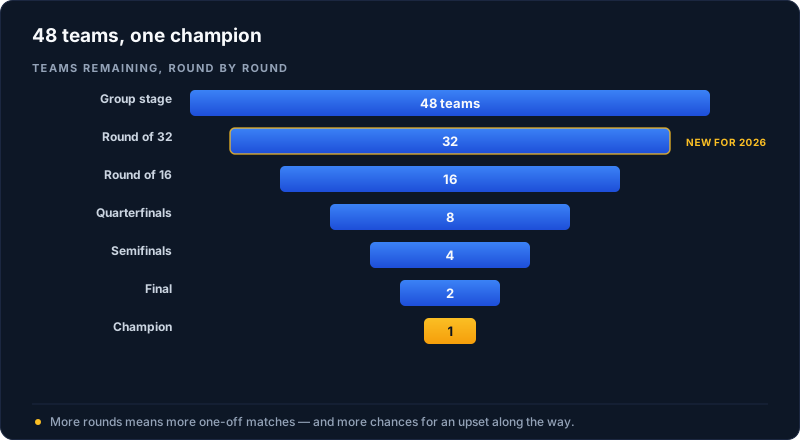
The 2026 World Cup is the largest in the tournament's history. Forty-eight teams, up from 32, play 104 matches across three countries and sixteen host cities. The expansion is not just more soccer. It changes the math of who reaches the late stages and how open the title race really is.
The field splits into twelve groups of four. The top two from each group advance, joined by the eight best third-placed teams, and together they fill a newly added Round of 32. From there it is straight knockout: Round of 16, quarterfinals, semifinals, final. The champion will play more matches than in any previous World Cup.
Adding sixteen teams brings in more sides that, on paper, are unlikely to go deep. That widens the gap at the top of some groups and makes a handful of group results more predictable than before. The expansion does not, on its own, make the strongest favorites any weaker.
What does move the odds is the longer knockout road. Every extra round is another single match, and a single match is where the better team is most likely to slip. We have written before about how often favorites lose one-off games; the more of them a would-be champion has to survive, the more chances for an upset to end the run.
The new Round of 32 is the clearest example. It hands strong teams one more knockout hurdle before the quarterfinals, often against a third-placed side with little to lose. Most of the time the favorite advances. Occasionally it does not, and the bracket cracks open early.
The hosts — the United States, Canada, and Mexico — give three teams a real home edge, but for everyone else the venues are neutral, which flattens the home advantage that shapes club competitions. Travel across a continent and summer heat in cities like Houston and Monterrey add their own wear, and both tend to favor the more rested, more technical side.
Put it together and the title picture is flatter than the old 32-team format. The best teams are still the best teams, but their path is longer and the field behind them is deeper, so the probability is spread across more contenders. A simulation of the tournament shows it directly: no single side runs away with it, and a cluster of teams sit within a few percentage points of each other at the top.
The practical read is to hold title odds loosely. A 12 percent favorite in a 48-team knockout is a genuine favorite and still far more likely to fail than to win, because seven straight one-off matches is a gauntlet. Reaching the final at all is an achievement the numbers respect.
On ParallaxEdge, the World Cup Simulator runs the full bracket fifty thousand times and aggregates the outcomes into title and advancement probabilities, updated daily. The Matches and Calendar pages carry per-fixture probabilities for all 104 games. Together they let you watch the wider field narrow, round by round, to a single champion.
Want deeper insights?
Join the waitlist for advanced simulations, full distributions, and model explanations.