Insights / Team Form
Team FormReading team form: signal and noise
ParallaxEdge Research · May 13, 2026 · 8 min read
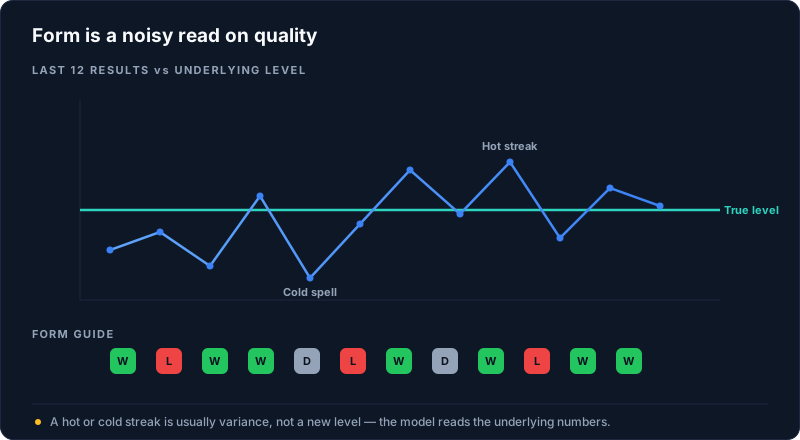
Form is the first thing fans reach for and the easiest thing to misread. A team wins four in a row and is suddenly flying; it loses two and the same squad is in crisis. Most of that swing is noise. The job of a model is to separate the part of recent form that reflects a real change in quality from the part that is just the scoreboard being noisy.
Form is a short window of results, usually the last five or six matches. Its appeal is that it is recent and concrete. Its weakness is that it is a tiny sample in a low-scoring sport — so it carries a lot of variance and not much signal. Five matches is enough for a hot streak or a cold one to appear out of pure chance, with no real change underneath.
The cleaner read is underlying performance, not results. A team can win three straight while being outchanced in all three, riding hot finishing and a goalkeeper in form. Another can lose two narrowly while creating the better chances in both. Expected goals cuts through this: it measures the quality of chances created and conceded, which is far steadier week to week than the goals that happened to go in.
This is why form regresses. A team performing far above its level tends to drift back toward it, and a team performing below it tends to climb back up, simply because extreme short runs are usually part luck. The mistake is to extend a streak forward as if it were the new normal. The model's job is to pull those extremes back toward the team's established level rather than chase them.
Sometimes form is real signal. A new manager, a key injury or return, a tactical switch, a back line that has finally settled: these change the underlying level, and the results that follow mean something. The trick is to look for a cause. Form with a reason behind it is worth weighting; form that is just a run of results is mostly variance.
Our model treats recent matches as evidence, not gospel. Newer results carry more weight than old ones, but every result is read against the team's longer-run strength and its underlying numbers. A four-game winning streak nudges a team's rating up — it does not rewrite it. The longer baseline keeps a hot week from overwhelming a season of evidence.
Streaks are seductive because the eye is built to see patterns, including ones that are not there. A run of wins feels like momentum carrying forward, but from one match to the next the link is weaker than it feels. Momentum is real within a single game; across a season it is mostly a story we tell after the fact.
So when you read a form guide, ask two questions. Were the results backed by the underlying performance, or was the team running hot or cold? And is there a reason for the change, or is it just a short run? Answer those and you will read form the way the model does: useful, recent, and easy to overrate.
On ParallaxEdge, you can see both sides of this. Team pages carry recent form alongside per-season expected-goals trends, so you can check whether results match the underlying numbers. Match Intelligence folds recent form into the win probabilities without letting it dominate, because the model is built to tell the difference between a team that has genuinely improved and one that has simply been lucky.
Want deeper insights?
Join the waitlist for advanced simulations, full distributions, and model explanations.