Education / Tournaments
Tournaments·7 min read·Intermediate
Why Upsets Happen in Knockout Soccer
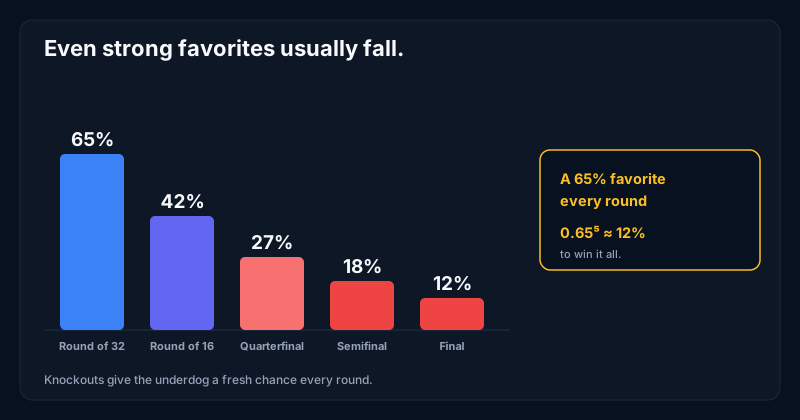
A clearly better soccer team can still lose a single knockout match, and across several rounds those small risks compound into upsets.
Soccer is one of the lowest-scoring major sports in the world, and that single fact explains a surprising amount about why tournaments are so unpredictable. When matches are routinely decided by one goal, the margin between winning and losing is razor-thin, and a huge share of that one goal can come from something almost random: a deflection off a defender's shin, a penalty awarded for a marginal handball, a red card that reshapes the next hour, or a goalkeeper who simply has the game of his life. Because so much hinges on so few events, even a clearly stronger team usually does not have an overwhelming edge in any individual match. A model might rate a strong favorite at something like a 60 to 65 percent chance to win a given game, which sounds dominant until you realize it also means that team loses or draws roughly a third of the time.
In a league, that built-in variance gets quietly smoothed away. Over a 38-game season, the unlucky deflections and hot goalkeepers and dubious penalties tend to cancel out, and the table gradually sorts teams by their true quality. A single bad afternoon barely dents a title race because there are dozens of other afternoons to make up for it. Knockout soccer offers no such mercy. One flat 90 minutes, one unfortunate bounce, one moment of brilliance from an underdog, and your tournament is simply over. There is no next week to set things right, no aggregate table to reward the better team for being better most of the time. The format takes the sport's natural noise and removes every mechanism that would normally average it out.
The deeper problem for favorites is that winning a knockout is not about surviving one match, it is about surviving several in a row, and probabilities multiply when they have to happen consecutively. Imagine a genuinely excellent team that is a 65 percent favorite in every single round it plays. That feels commanding round by round, yet to lift the trophy it might need to win five straight matches, and the math of stringing those together is unforgiving: 0.65 raised to the fifth power works out to roughly 12 percent. In other words, even a team that is the clear favorite in every game it plays is far more likely than not to be knocked out somewhere along the way. This is the heart of why upsets feel so common in knockouts. They are not flukes that defy the odds so much as the predictable consequence of asking a favorite to clear several hurdles without tripping once.
Knockout formats then pile on additional sources of randomness for any match that refuses to resolve in regulation. When a game is level after 90 minutes, it goes to extra time, where tired legs and thin squads can erase the gap between teams, and if it is still tied after that, it goes to a penalty shootout. A shootout is about as close to a coin flip as elite sport gets: even the best penalty takers miss, even modest goalkeepers guess right, and the better team over the previous two hours has no special protection once it comes down to spot kicks. Every drawn knockout match, in effect, attaches a near-random tiebreaker to the end of an already high-variance contest, handing the underdog yet another doorway into the next round.
This is also why the structure of a tournament matters so much, and why the expanded 2026 World Cup is worth paying attention to. With 48 teams instead of 32, the bracket now includes a Round of 32, an entirely new single-elimination round that sits before the stages fans are used to. Each additional knockout round is one more 90-minute window in which something strange can happen, one more chance for a favorite to run into a hot goalkeeper or a deflected winner before it ever reaches the final. More rounds do not just make the tournament longer; they multiply the opportunities for the underdog path to open up, which is precisely the dynamic that produces memorable upsets.
All of this is why our Monte Carlo simulator does not simply look at the bracket and crown the strongest team. Picking the favorite ignores everything we have just described: the thin margins, the compounding rounds, the coin-flip tiebreakers, the extra single-elimination stage. Instead, the simulator plays the entire tournament out tens of thousands of times, letting each match resolve according to its modeled probabilities and tracking who advances across every imagined run. By counting how often each outcome actually occurs across all those simulated tournaments, we can put a real number on something fans feel intuitively but rarely quantify: how often the underdog path genuinely happens, and just how likely even a dominant favorite is to fall short. The upset is not noise in the data. It is a feature of the format, and measuring it honestly is the whole point.
Want the full Learning Center?
Join the waitlist for premium guides, worked examples, and downloadable reference sheets.