Education / Modeling
Modeling·7 min read·Advanced
Why Bayesian? Priors and Regularization
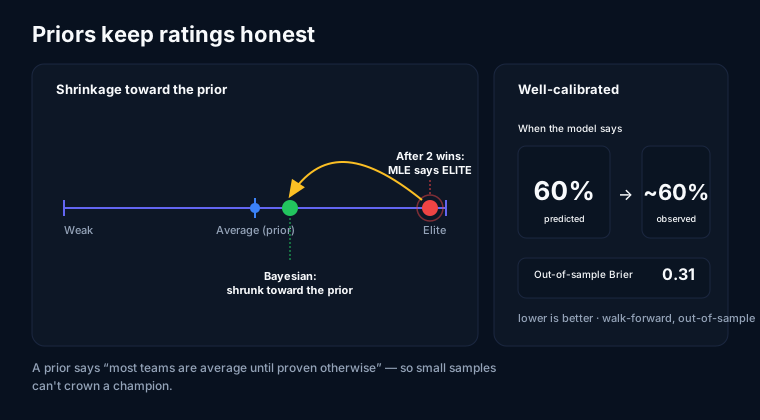
Fitting from data alone lets two lucky wins crown a champion; Bayesian priors keep ratings honest, stable, and trustworthy.
Imagine a team opens its season with two crushing 4-0 wins. If you build a rating purely from what you have seen, that team looks unstoppable, because the only evidence available is spectacular. This is the core weakness of fitting a model by maximum likelihood, the standard approach that asks, “What team strengths would make the results we observed most probable?” With a full season of data, that question has a sensible answer. With two games, it does not. The math has no way of knowing those wins came from a tiny sample, so it confidently reports an extreme rating. Small samples produce overreactions, and a model that overreacts will keep getting fooled.
The Bayesian approach fixes this by adding something the maximum-likelihood method lacks: a starting belief, called a prior. A prior is simply what you reasonably expect before you look at a particular team's results. A sensible prior for soccer is that most teams are roughly average until they prove otherwise, because that is what most teams actually are. Instead of reading the data in a vacuum, Bayesian fitting blends this prior belief with the observed results to reach a final estimate. The data still matters enormously, but it is no longer the only voice in the room.
That blending produces an effect called regularization, or shrinkage, and it is the heart of why this works. Because the prior pulls toward the average, extreme estimates get “shrunk” back toward the middle unless the evidence is strong enough to hold them out there. Two 4-0 wins do move a team's rating upward, as they should, but not to an absurd height, because two games are simply not enough evidence to overrule the prior. A long, consistent body of results is enough, and such a team's rating will climb and stay there. Shrinkage is exactly the discipline that stops a model from being fooled by a lucky or unlucky handful of matches.
The payoff shows up in three ways that fans and analysts actually feel. First, calibration: the probabilities mean what they say, so a stated 60 percent chance behaves like a real 60 percent over the long run. Second, stability: ratings evolve as evidence accumulates rather than lurching wildly after every result. Third, and crucially for a 48-team World Cup, sane estimates for teams with little recent international data. When the data is thin, the prior quietly fills the gap with “probably about average” instead of letting the model invent a wild guess from a few scattered matches.
This is not just theory; it earns its keep under testing. Evaluated out of sample on matches it never trained on, the Bayesian Dixon-Coles model scores a Brier of about 0.31 and stays well-calibrated — a stated 60 percent behaves like a real 60 percent. The reason for the Bayesian framing is what shrinkage does to the model's behavior: by pulling extreme ratings back toward the prior, it stops a lucky or unlucky handful of matches from producing overconfident probabilities, which is exactly what keeps the calibration honest. The Bayesian fit also produces credible intervals, ranges that express how sure the model is, and those intervals are what power the confidence gauge you see in the product.
One honest caveat keeps us grounded. A prior is an assumption, and a poorly chosen one can bias results just as surely as a small sample can; lean too hard on everyone being average and you will blunt the real signal from genuinely great or poor teams. The discipline, then, is choosing priors that are weak enough to let the data speak when it has something to say, yet strong enough to prevent nonsense when it does not. Done well, that balance is what turns raw results into ratings you can actually trust.
Want the full Learning Center?
Join the waitlist for premium guides, worked examples, and downloadable reference sheets.