Education / Modeling
Modeling·6 min read·Beginner
How Weather Affects Football Matches
Wind, rain, and heat measurably shift scoring. Here is how we fold weather into match projections.
Weather changes football matches, but usually less than fans assume. In any given fixture, the gap in squad quality, form, and tactical fit between the two sides will swamp whatever the sky is doing. Where weather does push the numbers, though, it tends to push them in fairly consistent directions, and the size of the effect is measurable across enough matches that we can talk about it honestly. This lesson is about which conditions actually move the math, by roughly how much, and how we plan to fold those adjustments into ParallaxEdge's per-fixture probabilities as the WC2026 tournament unfolds.
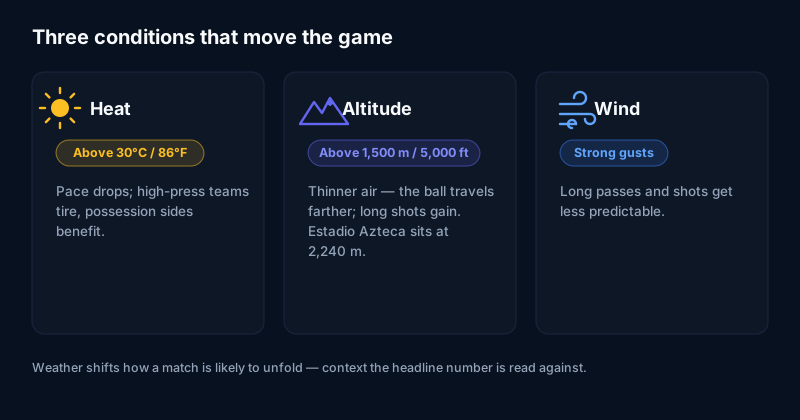
Wind is the most disruptive common weather factor. Once sustained wind crosses roughly 25 km/h, long passes start drifting, crosses float past their targets, and free kicks from outside the box convert at a noticeably lower rate than they do on calm days. Goalkeepers misjudge airborne balls more often, which sounds like it should boost scoring, but in practice both teams' expected goals drop a little. The team that relies on direct play, early crosses, and set-piece deliveries loses the most, because so much of what they do depends on the ball arriving where they aimed it.
Rain works through the grass more than through the air. A wet surface speeds the ball up and makes it skid through tackles, which intuitively sounds like it would reward the more technical side but actually tends to help the more direct team. Defenders mistime challenges, through-balls slip past control, and goalkeepers fumble shots they would normally hold. The net effect on total goals is roughly neutral, but the variance widens — rainy matches are more likely than dry ones to produce unusual scorelines, which is worth remembering when a 4-3 happens and everyone calls it a freak result.
Heat is the weather factor most relevant to WC2026. Once temperatures climb above about 30°C, or 86°F, the pace of play drops measurably from the second half onward. Substitutions become more valuable than usual, and teams whose structural advantage comes from a high press lose part of that edge, because pressing in real heat is exhausting and unsustainable. The slight beneficiary is the more technical, possession-based side, which can keep the ball and let the opposition chase. Several WC2026 venues — Houston, Dallas, Monterrey — are likely to hit these thresholds in afternoon kickoffs.
Cold is mostly a story about the ball. Below freezing, footballs are harder, less bouncy, and travel with less spin, and players take longer to get loose and reach full pace. The effect on actual outcomes is smaller than wind or heat, but it shows up clearly enough in cold-climate leagues to be detectable in the data. For WC2026 this matters less than it would for a Bundesliga match in February, because the tournament runs through North American summer. We mention it mainly so the framework is complete, and because cold conditions will matter for other competitions we cover later.
Altitude is the quietest of these factors and one of the most reliable. Above roughly 1500 meters, or 5000 feet, the air is thinner; the ball travels farther; long shots become more dangerous than they would be at sea level; and visiting teams typically need a day or two to adjust their breathing and recovery. Mexico City's Estadio Azteca sits at 2240 meters, and teams flying in from lower-altitude training bases regularly underperform their baseline expected goals there. Of the WC2026 host cities, only Mexico City and Guadalajara are at altitudes high enough for this to meaningfully bias a match.
The model that drives ParallaxEdge's WC2026 win probabilities does not currently condition on weather forecasts. That is a deliberate choice for launch, not an oversight. Pulling forecast data into the per-match pipeline so probabilities can adjust on matchday sits on our Tier-2 roadmap, and you will see it appear during the tournament. Until then, weather is one of the named caveats published with the model: when a fixture forecasts high wind or extreme heat or a venue like Azteca, the headline probability should be read as the baseline before that adjustment, not as the final word.
An honest sense of magnitude helps here. A typical weather adjustment shifts a headline win probability by something like one to three percentage points, not ten. Weather has more pull on scoring totals — how many goals get scored, by whom, with what variance — than on which side actually wins. The right way to use it is as a tiebreaker between roughly equal sides, or as context for why a final score looked unusual. It is not a reason to override the model when one team is clearly stronger. Sports, quantified, means knowing which effects are big and which are small.
Want the full Learning Center?
Join the waitlist for premium guides, worked examples, and downloadable reference sheets.