Education / Stats Explained
Stats Explained·6 min read·Beginner
Home Advantage: How Much Is It Worth?
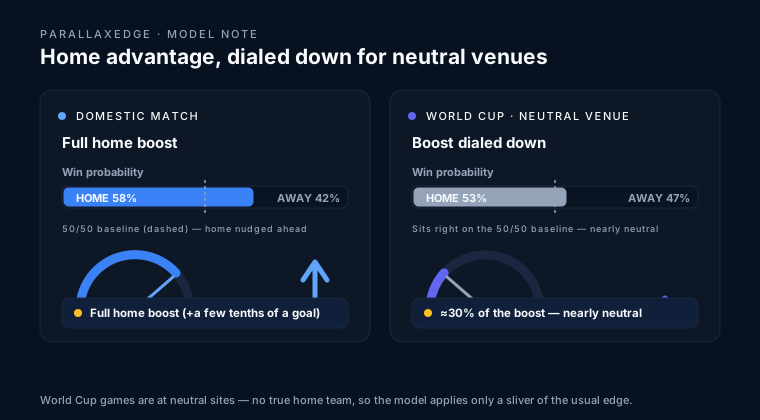
Home advantage is one of sport's most dependable effects, and a good model has to know exactly when to trust it.
Home advantage is one of the most reliable effects in all of team sports. Across leagues, seasons, and decades, home sides simply win more often than those very same teams do when they travel. It is not a quirk of one club or one country; it shows up almost everywhere people have looked. The size of the effect shifts from league to league, but the direction almost never does. When you see a team listed as the home side, you are already looking at a small but real edge before anyone has kicked a ball.
Why does playing at home help so much? The honest answer is that it is a bundle of smaller causes rather than a single magic ingredient. A supportive crowd appears to lift the players a little and, more subtly, to nudge referees toward marginal decisions that favor the home team. The home side also knows its own pitch and conditions intimately, from the dimensions and surface to the weather and the feel of the stadium. And the visitors carry costs the hosts do not: travel, disrupted routines, and the fatigue that comes with being away from home. Stack those together and you get a consistent, measurable tilt.
So how does a forecasting model capture something this fuzzy? It treats home advantage as an explicit, separate term. Every team carries its own attack and defense ratings, and the model uses those to estimate how many goals each side is likely to score. On top of that, it adds a home-advantage boost to the home team's expected goals, before any team-specific quality is factored in. In practice this boost is worth a few tenths of a goal, which translates into a meaningful but modest bump in win probability toward the home side. Crucially, it is learned from data, not assumed, so the model knows roughly how large the effect tends to be.
Here is where the World Cup 2026 forecasts demand special care. Most World Cup matches are played at neutral venues, so neither side is genuinely at home and the home/away listing is just an arbitrary label. The real exception is the three host nations: when the United States, Canada, or Mexico play in their own country, the crowd, the absence of travel, and the familiarity are genuinely theirs. So our model decides home advantage by venue country — a host playing at home receives the full home-advantage edge, while every genuinely neutral match (including a host playing in another host's country) receives none at all. Applying a blanket boost to a neutral-site match would quietly bias the forecast toward whichever team happened to be listed first; tying the edge to the actual venue avoids that while still crediting the hosts the real advantage they have.
A few caveats keep this honest. Home advantage is an average effect, not a promise; plenty of home teams lose, and the boost simply shifts the odds rather than guaranteeing a result. The size of the effect also varies by league and has slowly declined over the decades as travel got easier and pitches grew more uniform. The most telling evidence comes from matches played in empty or reduced-crowd stadiums, where the advantage visibly shrinks. That drop is a big part of why analysts believe the crowd genuinely matters, rather than home advantage being purely about familiarity or travel.
This is why ParallaxEdge handles the World Cup the way it does. On a typical domestic fixture page you will see the home side carrying a clear, data-backed edge. On a neutral World Cup fixture you will see no home-advantage swing at all, because neither team is home. The host nations are the exception: in their own stadiums they carry their full, earned edge, and everyone else competes on level ground. It is a small choice with a big payoff: forecasts that reflect how the tournament is actually played — neither pretending a neutral stadium is somebody's backyard, nor pretending a host nation's home crowd does not exist.
Want the full Learning Center?
Join the waitlist for premium guides, worked examples, and downloadable reference sheets.