Education / Tournaments
Tournaments·5 min read·Beginner
Extra Time and Penalties, Explained
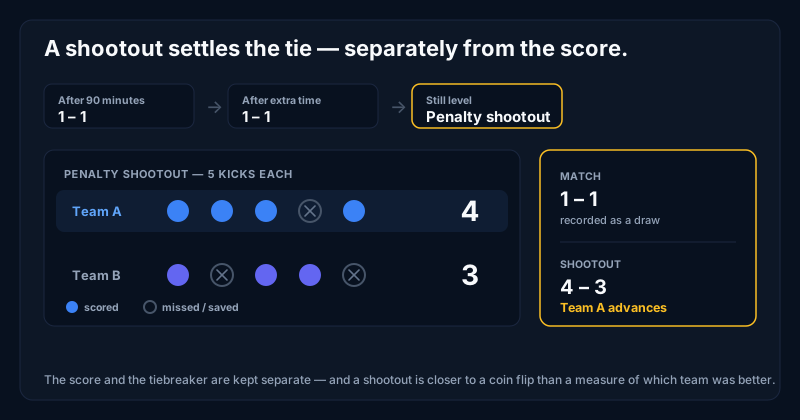
A knockout match can't end level, so a tie goes to extra time and then a penalty shootout — here's how that works, and how to read it on ParallaxEdge.
In the group stage a match can simply end in a draw — both teams take a point and move on. The knockout rounds don't have that luxury: exactly one team has to advance. So when a knockout match is level after the usual 90 minutes, the game isn't over. It goes to extra time — two further periods of fifteen minutes, played in full. If the score is still level after those thirty minutes, the tie is settled by a penalty shootout.
A shootout is its own small contest. Each team takes five penalties, alternating, and whoever scores more wins. If they are still tied after five each — which happens often — it goes to sudden death: the teams trade penalties one for one until, in a single round, one scores and the other misses. Penalties are converted around three-quarters of the time, so a shootout usually turns on one or two misses or a single save, which is why the margin tends to be tight, like 4–3 or 5–4.
On ParallaxEdge, a match decided this way keeps its real scoreline. If a game finished 1–1 after extra time and one side won the shootout, we show the result as 1–1 and note the shootout separately — for example, “Paraguay won 4–3 on penalties.” That mirrors how football itself records it: the shootout decides who advances, but it is never folded into the score. The 1–1 is the true result of the match; the 4–3 is the tiebreaker that followed.
This is also why you will sometimes see a knockout game our model called a “draw” even though a team clearly advanced. Our win, draw, and loss probabilities describe the match through those 120 minutes — the part driven by qualities we can measure, like attacking and defensive strength. A shootout is not really one of those; it is far closer to a coin flip than a skill gap, so we do not treat it as part of the forecast. When the model says “draw” and a team goes through on penalties, both things are true at once: the match was level, and the shootout broke the tie.
That gap between the match and the shootout is worth sitting with, because it is a big part of why knockouts are so unpredictable. A clearly stronger team can dominate for two hours, fail to convert that edge into a goal, and then exit on a single missed penalty. When that happens it is not evidence that the model misjudged the teams — it is the format adding one last, deliberately random tiebreaker at the very end. For more on how that randomness compounds across a bracket, see “Why Upsets Happen in Knockout Soccer.”
Want the full Learning Center?
Join the waitlist for premium guides, worked examples, and downloadable reference sheets.